We have many events in Kyoto during summer holiday.
Have you ever seen any Japanese firework display before?
As one of famous firework festivals, there is Firework Festival in Uji, namely Ujigawa Hanabi Taikai (宇治川花火大会).
Firework Festival in Uji
Date August 11th, 2014
Time 19:45 - 20:45
*will be postponed until August 14th in the case of heavy weather.
Place Uji Park Nakanoshima, near the Uji River
*There are some areas for pay seats in the place (Advance booking and tickets required).
Access JR Uji Station (Nara Line)
*17 minutes by "Kaisoku" from Kyoto Station
You can see a display of fireworks on the river. This year, the theme for the firework display is "Genji roman (源氏ロマン)," which is expressed as the world of "Genji-Monogatari," the Tales of Genji.
Murasaki-shikibu (紫式部) produced a literary work called "Genji-Monogatari" during Heian Era. Nowadays you can read this old novel in English. There is an English book called "the Tales of Genji" translated with an introduction by Edward G. Seidensticker.
You can feel the world of Genji-Monogatari by seeing the display of fireworks!
Jul 24, 2014

Jul 12, 2014
Entokuin Temple
Entokuin Temple was built by Nene, who was known
as Kitano Mandokoro
(wife of Toyotomi Hideyoshi) to mourb her husband in 1605.
She spent her last years here.
It has been strongly influenced by Zen.
You will enjoy delicious Japanese sweets and tea.

(wife of Toyotomi Hideyoshi) to mourb her husband in 1605.
She spent her last years here.
Open: Genaral 10:00am – 5:00pm
Special season (illumination show at nighttime) 10:00am – 9:30pm
Special season (illumination show at nighttime) 10:00am – 9:30pm
Holiday: Closed certain days for affairs of the temple.
Please confirm by telephone.
Charge: General: 500yen
High School Student and under: 200yen
High School Student and under: 200yen
●Feel heart of Japanese culture
In the tearoom of Entokuin, you will be able to
experience the tea ceremony.
The tea ceremony is a traditional Japanese culture.It has been strongly influenced by Zen.
You will enjoy delicious Japanese sweets and tea.
・Charge: 500yen (also needed admission)
・Time is up to 4:00pm from 10:00am
*The
reservation is not needed.
Jul 5, 2014
Ukai Cormorant Fishing
July 1-Sept. 15
Ukai Cormorant Fishing in Arashiyama

Ukai is a traditional fishing method in which cormorants (large diving birds) are used to catch sweet river fish or ayu; Carried out on the Oi River, this event is one of the most popular summer tourist attractions in Arashiyama; Tourists can watch the event either from banks of the river or get a seat on a boat which let them watch the performance up close.
Adults: 1,700 yen, Children (4-12 years old): 850 yen; 19:00-21:00; Boat ride: 19:00 & 20:00; No service on Aug. 16; Access: Kyoto City Bus #28, get off at Arashiyama Koen; Arashiyama Tsusen: Tel: 075-861-0302.
Ukai Cormorant Fishing in Arashiyama
Ukai is a traditional fishing method in which cormorants (large diving birds) are used to catch sweet river fish or ayu; Carried out on the Oi River, this event is one of the most popular summer tourist attractions in Arashiyama; Tourists can watch the event either from banks of the river or get a seat on a boat which let them watch the performance up close.
Adults: 1,700 yen, Children (4-12 years old): 850 yen; 19:00-21:00; Boat ride: 19:00 & 20:00; No service on Aug. 16; Access: Kyoto City Bus #28, get off at Arashiyama Koen; Arashiyama Tsusen: Tel: 075-861-0302.
Jun 26, 2014
Gion Festival
Gion Festival, The most famous festival oh Kyoto will come soon!
Here is the schedule:
The streets are lined with night stalls selling food such as takoyaki, sweets, and many other culinary delights. Many girls dressed in yukata(summer kimono) walk around the area.
During the Yoiyama evenings leading up to the parade, some private houses in the old kimono merchant district open their entryways to the public, exhibiting valuable family heirlooms. This is a precious opportunity to visit and observe traditional Japanese residences of Kyoto.
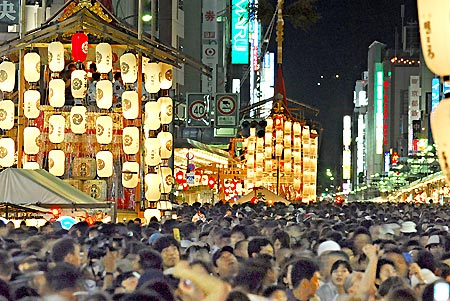
Here is the schedule:
- July 7: Shrine visit by chigo children of Ayagasaboko
- July 10: Lantern parade to welcome mikoshi portable shrines
- July 10: Mikoshi arai, cleansing of mikoshi by sacred water from the Kamo River
- July 10 through 13: Building-up of floats(Former parade)
- July 13 a.m.: Shrine visit by chigo children of Naginataboko (in the morning)
- July 13 p.m.: Shrine visit by chigo children of Kuse Shrine (in the afternoon)
- July 14: Yoiyoiyoiyama(Former parade)
- July 15: Yoiyoiyama(Former parade)
- July 16: Yoiyama(Former parade)
- July 16: Yoimiya shinshin hono shinji, dedicative art performances
- July 17: Parade of yamaboko floats(Former parade)
- July 17: Parade of mikoshi from Yasaka Shrine to the city
- July 18 through 20: Building-up of floats(Latter parade)
- July 21: Yoiyoiyoiyama(Latter parade)
- July 22: Yoiyoiyama(Latter parade)
- July 23: Yoiyama(Latter parade)
- July 24: Parade of yamaboko floats(Latter parade)
- July 24: Parade of hanagasa or "flower parasols"
- July 24: Parade of mikoshi from the city to Yasaka Shrine
- July 28: Mikoshi arai, cleansing of mikoshi by sacred water from the Kamo river
The streets are lined with night stalls selling food such as takoyaki, sweets, and many other culinary delights. Many girls dressed in yukata(summer kimono) walk around the area.
During the Yoiyama evenings leading up to the parade, some private houses in the old kimono merchant district open their entryways to the public, exhibiting valuable family heirlooms. This is a precious opportunity to visit and observe traditional Japanese residences of Kyoto.
Jun 21, 2014
Kuroda Seiki on exhibition
At The Museum of Kyoto
June 7th - July 21st
Open: 10am - 6pm, until 7:30pm Friday
Closed: Monday
Admission: 1,200JPY
Access: Subway 3 minutes' walk from the 5th exit of Karasuma Oike Station
*** Kuroda Seiki ***
Leading figure in late 19th to early 20th century Western style painting in Japan, who studied in France, exhibited Japan's first nude.
Perhaps Kuroda's greatest contribution to Japanese culture was the acceptance of Western-style painting he fostered on the part of the Japanese public. Despite their initial reluctance, he was able to convince them to accept the validity of the nude figure as a subject for art.

June 7th - July 21st
Open: 10am - 6pm, until 7:30pm Friday
Closed: Monday
Admission: 1,200JPY
Access: Subway 3 minutes' walk from the 5th exit of Karasuma Oike Station
*** Kuroda Seiki ***
Leading figure in late 19th to early 20th century Western style painting in Japan, who studied in France, exhibited Japan's first nude.
Perhaps Kuroda's greatest contribution to Japanese culture was the acceptance of Western-style painting he fostered on the part of the Japanese public. Despite their initial reluctance, he was able to convince them to accept the validity of the nude figure as a subject for art.
Jun 2, 2014
Insho Domoto musium
There is a homy museum in North area in Kyoto,which is called`Insho Domoto museum'.
It is not so big,not so crowded.
Everything in there is just good balance.
If you feel tired of too big museum,you'd better to visit and spend time there.
His sculptures which are spread in there is also nice to see!
Just cute!
 http://insho-domoto.com/index-e.html

May 30, 2014
Ajisai-Matsuri in Sanzenin
The rainy season is setting
in soon.
In Kyoto, we usually have such rainy
days especially in June.
However, we have special
events during the gloomy season.
The rainy season makes us
think of hydrangeas in Japan and the best to see full-blown flowers in a year.
Sanzenin is the temple for
Tendai sect of Buddihism in Ohara area in Kyoto.
Its initial opening was
1,200 years ago.
During the rainy season, we
can see about 3,000 hydrangeas in the temple.
For the best season for hydrangeas, there is Ajisai-Matsuri in Sanzenin
from June 16th to Jul 15th.
On the first day of the
festival, we have a reading ceremony for Daihannya-kyo (Great Perfection of Wisdom
Sutra) and Saitougomaku.
Saitougomaku is the general
name of religious rites to wish no occurrence of disasters by firing and
smoking some holy trees called “Gomagi.”
Ajisai-Matsuri in Sanzenin
June 16th ~ July 15th
On June16th:11:00~ Daihannya-kyo, 13:30~Saitogomaku in Konjikifudo-do
Sanzenin
March - October 9:00~17:00 (closing time: 17:30)
November 8:30~17:00 (closing time: 17:30)
December - February 9:00~16:00 (closing time: 17:30)
Admission: Adult 700yen, Junior high school student 400yen, Elementary school student 150yen
Access: Kyoto Bus no.17 from Kyoto Station (C3) to Ohara
We also can feel cooler in Ohara than the
centre of Kyoto city.
Why don’t you visit Sanzenin so as to
forget the heat?
Subscribe to:
Posts (Atom)


 Posts
Posts

