Showing posts with label festival. Show all posts

Apr 24, 2018

KYOTOGRAPHIE time

Kyoto never failed to impress me with many cultural things to offer all year around.

Kyotographie is one of my favorite events of the year - annual photo exhibition throughout the city from mid April to mid May, and the biggest reason why I'm so intrigued is the venues of this event. You can enter the world of "unreal" in this touristic city through Kyotographie.

Some of the unique locations this year:
Kyoto Shimbun B1, Former Printing Plant
Image result for kyotographie 京都新聞

Sazanga-Kyu(Former Ice Factory)


Image result for kyotographie 三三九

Kyoto City Central Wholesale Market, Bldg No. 10, 11 south wall
Related image

You can visit all the cool places that are usually closed and forgotten, it's so inspiring!

Until 13th May
https://www.kyotographie.jp/


Jan 8, 2018

New Sightseeing Spot in Kyoto

Happy New Year 2018!

Crowded new year's eve and new year's holidays  already became past.
And sadly Kyoto is about to enter "apparently nothing's going on" time of the year.

It's cold, no event going on, no flower etc...
Oh yes I cannot deny those, but! there is a new place to go for you.

It's 十二十二 (Toni Toni) close by Heian Jingu shrine, in Okazaki area where there are many museums and some small nice cafes and restaurants.

It just opened last December and it features Jidai Mastri (時代祭) which is held in October every year. In the festival, people with traditinal clothings from each historical era maech around the city of Kyoto, and at Toni Toni, you can enjoy the festival anytime of the year.

There are also some restaurants and cafes:)

Add Toni Toni to things to do list!!

Website: http://1022.kyoto.e.adg.hp.transer.com/

Jan 4, 2018

Toka Ebisu

For five lively days in January thousands throng to a small shrine in Gion to pray to Ebisu, the god of good fortune. 

The first major festival of the year in Kyoto is Toka Ebisu. “Toka” means the tenth day, and Ebisu is the god of good fortune and prosperity. Though centred on the 10th of January, this festival actually lasts for five days from the 8th until the 12th. During this time thousands of visitors crowd into Ebisu Shrine to conduct a simple ritual of prayer for ongoing success in their work and business.
Many people buy branches of lucky bamboo grass, called Fuku-Zasa which has been blessed in a special ritual by a shrine maiden. They then buy more lucky charms and talismans, which they attach to the bamboo branch. These charms come in all kinds of designs, but two of the most common are treasure boats for wealth and red sea bream for future success.

Throughout the festival there are a number of special ceremonies and events such as Mochi-tsuki, the Rice Pounding Ritual, 

and the Hoekago parade by performers from Toei Kyoto Studio Park etc...

Also this festival is a good opportunity to see maiko, the apprentice geisha of Kyoto. On the afternoon of January 11th, maiko from the geisha district of Gion sit in the main hall and give out lucky rice cakes and branches of lucky bamboo grass. In the evening maiko from the Miyagawa district do the same. This is when sales of lucky bamboo grass reach their peak!
Personally, my favorite part of this festival is simply wandering by the festival stalls that line the streets leading to Ebisu Shrine. All kinds of cheap goods are on offer and plenty of food and drink. When night descends the streets seem to come alive with illuminated colourful stalls selling tako-yaki octopus dumplings, kara-age deep fried chicken, and ringo-ame candy apples. Local restaurants are also busy with hungry pilgrims. Some stalls sell hot sake, and others sell hot wine. Truly, for a little while, Ebisu has brought good cheer and prosperity to this area at least.
Toka Ebisu Festival Date and Time
January 8th 9 AM - 11 PM
January 9th 9 AM - January 11th midnight (open all day, all night)
January 12th 9 AM - 10 PM
Ebisu shrine is 5 mins walk form exit #1 @ Keihan railway

Jul 8, 2017

Fushimi Inari Summer Festival

On this month, there is the summer festival at Fushimi Inari shrine.

It will be decorated by millions number of red paper lanterns and give you nostalgic atmosphere. It is definitely worth to see !


Date & Time : July 22nd from 6 pm, July 23rd from 9 am


You can also experience ”Bon dance". (Bon dance is originally an event to calm the ancestral spirits that came back during Obon season. However, it is enjoyed as a recreational event nowadays and the religious meaning has softened.)


Jan 3, 2017

Toka Ebisu Fes !!!

A very happy new year !

The first festival in Kyoto we introduce here is Toka Ebisu festival :)


It will be held at Ebisu shrine from January 8th to 12th.
For five lively days in January thousands throng to a small shrine in Gion to pray to Ebisu, the god of good fortune.
During these 5 days, there will be many events and also so many food stands are opened around the shrine. You can definitely enjoy this event !

So why don't you go and get fortune !?

For further questions, please refer to the following link as below ;
http://www.insidekyoto.com/toka-ebisu


Oct 6, 2016

Awata Festival

Awata Shrine is in Gion Area which is not one of Kyoto's famous shrines though, it is popular in autumn for its tunnel of coloured leaves.
And it has a big festival in this month!


Oct. 9th (from 18:00)
-Awata Huge Lanterns-
 Various kinds of lanterns will parade around the shrine.

-Yowatari Shinji-
 Shinto priests and monks will welcome the divine spirit by walking around the stone called “Uryuseki” for three times.This Shinto ritual is a ceremony to give thanks to god of Awata who descended.


Oct. 10th (from 12:30)
-Shinkosai-
  It is held to give strength to shrine parishioners by parading around the area.
  On this day, more than 200 people will carry huge Mikoshi (portable shrines) around the town.       Also, group of people who hold long-handled spears will purify the parade road by the spears.       Although these spears weight about 40 - 60 kilogram and height about 7 - 8 meters, people who   hold them balance well while parading.


Oct. 15th (from 11:00)
-Reitaisai-
 Bugaku (court dance and music) will be performed on the stage.


Access: 7min walk from Subway Tozai Line "Higashiyama Station"
            5min walk from "Jingu-michi Bus Stop"


Oct 3, 2015

Otsu Matsuri (Festival)


Otsu Matsuri

October 10th From evening to 21:00
October 11th From 9:00-17:30

You can see the festival around JR Otsu Station which is only 10min from Kyoto Station.

This dazzling autumn celebration of Tenson Shrine is one of the Three Great Festivals of Shiga.  The Otsu Festival has a history of nearly 400 years. It is said to have begun in the early Edo period (1603-1868) in the tanuki (raccoon dog) mask dance of a salt peddler named Jihee. The tanuki mask tradition has been preserved as an Otsu Municipal Cultural Property, and as the festival's roots lie in these masks, each year the Saigyo-Sakura-Tanuki float from Kajiya-cho leads the festival procession.
The Otsu Festival has many attractions—most notably the thirteen extravagant floats adorned with tapestries and other ornaments which parade throughout town on the day of the festival and the lively festival music that can be heard reverberating endlessly throughout Otsu's neighborhoods on the eve of the procession. 


Jul 1, 2015

Gion Matsuri Festival 2015


If you are visiting Kyoto in summer, You don't miss the Gion Matsuri Festival!
It's one of the largest and most historical festivals in Japan.
Why don't you wear a Yukata (= kimono for summer. It's not expensive, easy to wear and washable!!) and hang out in the Festival!?


Gion Matsuri Festival Event Calendar


JULY 10-14
Hoko and Yama Tate (float construction):
On these five days, the festival's 32 floats are assembled. No nails are used.

10
Omukae Chochin (welcoming lanterns):
At around 16:30, men wearing formal kimono and carrying long bamboo poles from which lanterns are suspended, depart from Yasaka Shrine, heading west along Shijo to Kawaramachi.

10
Mikoshi Arai (mikoshi purification):
During the festival, the deities of Yasaka Shrine reside in a temporary shrine called the Otabisho. Before moving the deities on the mikoshi portable shrines, the mikoshi are purified with water from Kamogawa River. The mikoshi depart from Yasaka Shrine at 19:00 and arrive at the bridge at 20:00, then come back to the shrine at 21:00.

12-14
Hoko Hikihajime & Yama Kakizome (trial pulling):
On these days, the people of each respective float neighbourhood try pulling the newly constructed floats.

14-16
Yoiyama (eve of the grand parade):
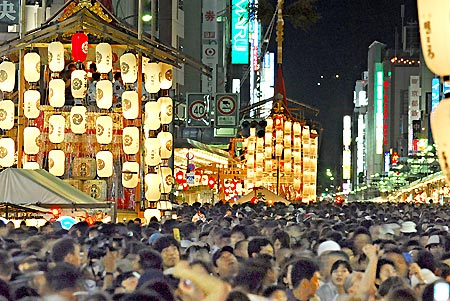
On the three nights before the grand parade, the festive atmosphere reaches its peak. The streets are crowded with people, many in traditional dress, Gion bayashi music fills the air, and many stalls are set up along the main streets.

15
Traditional Entertainment Performance:
On this day, at Yasaka Shrine, from 15:00 to 18:00, traditional Japanese entertainment (kabuki, biwa lute, harp, kyogen, dance, etc.) will be performed.

16
Iwami Kagura (ancient court dance):
From 19:00 at Yasaka Shrine, ancient court dance will be performed to the music of flute and bells.

17
Yamaboko Junko (grand parade):
At 9:00, the main Naginata-boko starts moving. When it reaches Fuyacho, the chigo sacred child on the float cuts the sacred rope and the parade begins.

24
Hanagasa Junko (flower umbrella procession):
At 10:00, about ten large umbrella floats attended by nearly 1,000 people depart from Yasaka Shrine. Various dances will be performed.

25
Kyogen Performance:
At 13:00, the Shigeyama Family will perform special kyogen (comical theatre) plays at Yasaka Shrine.

28
Mikoshi Arai (mikoshi purification):
As on the 10th, the mikoshi are again purified on Shijo Bridge at 20:00 before the deities are carried back to Yasaka Shrine from their temporary home, the Otabisho.

Oct 10, 2014

LET'S SEE THE LOCAL FESTIVALS TOGETHER!

Cecilia, Our Funky Sexy Staff will take you to see the local festivals!
We do not charge anything. Please just pay for train. (If you have JR pass, it is almost free.)
Please sign up at the reception as soon as possible  :-)

NOV 11th (Sat)
KISHIWADA DANJIRI & LOCAL OSAKA

11am Lobby --> JR train to Kishiwada --> See the festival for few hours --> Go to Shin Imamiya to have onsen or beer! ---> Back to Kyoto 
990yen/one way train


NOV 15th (Wed)
HIMEJI CASTEL AND FIGHTING FESTIVAL

9am Lobby ---> JR train to Himeji --> See the castle for few hours --> Sanyo train --> See the festival for few hours --> Back to Kyoto
2100yen/one way train


Jun 26, 2014

Gion Festival

Gion Festival, The most famous festival oh Kyoto will come soon!
Here is the schedule:

  • July 7: Shrine visit by chigo children of Ayagasaboko
  • July 10: Lantern parade to welcome mikoshi portable shrines
  • July 10: Mikoshi arai, cleansing of mikoshi by sacred water from the Kamo River
  • July 10 through 13: Building-up of floats(Former parade)
  • July 13 a.m.: Shrine visit by chigo children of Naginataboko (in the morning)
  • July 13 p.m.: Shrine visit by chigo children of Kuse Shrine (in the afternoon)
  • July 14: Yoiyoiyoiyama(Former parade)
  • July 15: Yoiyoiyama(Former parade)
  • July 16: Yoiyama(Former parade)
  • July 16: Yoimiya shinshin hono shinji, dedicative art performances
  • July 17: Parade of yamaboko floats(Former parade)
  • July 17: Parade of mikoshi from Yasaka Shrine to the city
  • July 18 through 20: Building-up of floats(Latter parade)
  • July 21: Yoiyoiyoiyama(Latter parade)
  • July 22: Yoiyoiyama(Latter parade)
  • July 23: Yoiyama(Latter parade)
  • July 24: Parade of yamaboko floats(Latter parade)
  • July 24: Parade of hanagasa or "flower parasols"
  • July 24: Parade of mikoshi from the city to Yasaka Shrine
  • July 28: Mikoshi arai, cleansing of mikoshi by sacred water from the Kamo river
I guess the Yoiyama of July 14-16 are fun for foreign tourists.
The streets are lined with night stalls selling food such as takoyaki, sweets, and many other culinary delights. Many girls dressed in yukata(summer kimono) walk around the area.
During the Yoiyama evenings leading up to the parade, some private houses in the old kimono merchant district open their entryways to the public, exhibiting valuable family heirlooms. This is a precious opportunity to visit and observe traditional Japanese residences of Kyoto.


May 30, 2014

Ajisai-Matsuri in Sanzenin


 The rainy season is setting in soon. 
In Kyoto, we usually have such rainy days especially in June.
However, we have special events during the gloomy season.

 The rainy season makes us think of hydrangeas in Japan and the best to see full-blown flowers in a year.
Sanzenin is the temple for Tendai sect of Buddihism in Ohara area in Kyoto.
Its initial opening was 1,200 years ago.
During the rainy season, we can see about 3,000 hydrangeas in the temple.

 For the best season for hydrangeas, there is Ajisai-Matsuri in Sanzenin from June 16th to Jul 15th.
 On the first day of the festival, we have a reading ceremony for Daihannya-kyo (Great Perfection of Wisdom Sutra) and Saitougomaku.
Saitougomaku is the general name of religious rites to wish no occurrence of disasters by firing and smoking some holy trees called “Gomagi.”

Ajisai-Matsuri in Sanzenin
June 16th ~ July 15th
On June16th:11:00~ Daihannya-kyo, 13:30~Saitogomaku in Konjikifudo-do


Sanzenin
March - October           9:00~17:00 (closing time: 17:30)
November                    8:30~17:00 (closing time: 17:30)
December - February   9:00~16:00 (closing time: 17:30)

Admission: Adult 700yen, Junior high school student 400yen, Elementary school student 150yen
Access: Kyoto Bus no.17 from Kyoto Station (C3) to Ohara


 We also can feel cooler in Ohara than the centre of Kyoto city.
 Why don’t you visit Sanzenin so as to forget the heat?